Posts

Showing posts with the label AAAL

William Kennedy, Ironweed, 1983

Image
In this Pulitzer Prize-winning novel, the third in Kennedy ’s Albany cycle, Francis Phelan, ex-ballplayer, part-time gravedigger, and full-time bum with the gift of gab, has hit bottom. Years earlier he’d left Albany after he dropped his infant son accidentally, and the boy died.  Now, in 1938, Francis is back in town, roaming the old familiar streets with his hobo pal, Helen, trying to make peace with the ghosts of the past and present. [ Source ] Ironweed  

John Irving, The World According to Garp, 1978

Image
Powerful and political, with unforgettable characters and timeless themes, The World According to Garp is John Irving ’s breakout novel. The precursor of Irving’s later protest novels, it is the story of Jenny, an unmarried nurse who becomes a single mom and a feminist leader, beloved but polarizing—and of her son, Garp, less beloved but no less polarizing.  From the tragicomic tone of its first sentence to its mordantly funny last line—“we are all terminal cases”— The World According to Garp maintains a breakneck pace. The subject of sexual hatred and violence—of intolerance of sexual minorities, and sexual differences—runs through the book, as relevant now as ever. Available in more than forty countries—with more than ten million copies in print— Garp is a comedy with forebodings of doom. [ Source ]  

Maxine Hong Kingston, The Woman Warrior, 1976

Image
The Woman Warrior: Memoirs of a Girlhood Among Ghosts is a book written by Chinese American author Maxine Hong Kingston and published by Alfred A. Knopf in 1976. The book blends autobiography with old Chinese folktales. The Woman Warrior won the National Book Critics Circle Award and was named one of TIME magazine's top nonfiction books of the 1970s. [ Source ] As a girl, Kingston lives in two confounding worlds: the California to which her parents have immigrated and the China of her mother’s “talk stories.” The fierce and wily women warriors of her mother’s tales clash jarringly with the harsh reality of female oppression out of which they come. Kingston’s sense of self emerges in the mystifying gaps in these stories, which she learns to fill with stories of her own. A warrior of words, she forges fractured myths and memories into an incandescent whole, achieving a new understanding of her family’s past and her own present. [ Source ]  

E. L. Doctorow, Ragtime, 1975

Image
Ragtime is a novel by E. L. Doctorow , published in 1975. It is a work of historical fiction mainly set in the New York City area from 1902 until 1912. In 1998, the Modern Library ranked Ragtime number 86 on its list of the 100 best English-language novels of the 20th century. TIME included the novel in its 100 Best English-Language Novels from 1923 to 2005. [ Source ]  The story opens in 1906 in New Rochelle, New York, at the home of an affluent American family. One lazy Sunday afternoon, the famous escape artist Harry Houdini swerves his car into a telephone pole outside their house. And almost magically, the line between fantasy and historical fact, between real and imaginary characters, disappears. Henry Ford, Emma Goldman, J. P. Morgan, Evelyn Nesbit, Sigmund Freud, and Emiliano Zapata slip in and out of the tale, crossing paths with Doctorow's imagined family and other fictional characters, including an immigrant peddler and a ragtime musician from Harlem whose insistence o...

Charles Wright, Black Zodiac: Poems, 1997

Image
  Black Zodiac offers poems suffused with spiritual longing―lyrical meditations on faith, religion, heritage, and morality. The poems also explore aging and mortality with restless grace. Approaching his vast subjects by way of small moments, Wright magnifies details to reveal truths much larger than the quotidian happenings that engendered them. His is an astonishing, flexible, domestic-yet-universal verse. As the critic Helen Vendler has observed, Wright is a poet who "sounds like nobody else." [ Source ]

Tobias Wolff, The Barracks Thief, 1984

Image
The Barracks Thief is the story of three young paratroopers waiting to be shipped out to Vietnam. Brought together one sweltering afternoon to stand guard over an ammunition dump threatened by a forest fire, they discover in each other an unexpected capacity for recklessness and violence. Far from being alarmed by this discovery, they are exhilarated by it; they emerge from their common danger full of confidence in their own manhood and in the bond of friendship they have formed. This confidence is shaken when a series of thefts occur. Tobias Wolff embraces the perspectives of both the betrayer and the betrayed, forcing us to participate in lives that we might otherwise condemn, and to recognize the kinship of those lives to our own. [ Source ]  

Garry Wills, Lincoln at Gettysburg: The Words that Remade America, 1992

Image
The power of words has rarely been given a more compelling demonstration than in the Gettysburg Address. Lincoln was asked to memorialize the gruesome battle. Instead he gave the whole nation “a new birth of freedom” in the space of a mere 272 words. His entire life and previous training and his deep political experience went into this, his revolutionary masterpiece. By examining both the address and Lincoln in their historical moment and cultural frame, Wills breathes new life into words we thought we knew, and reveals much about a president so mythologized but often misunderstood. Wills shows how Lincoln came to change the world and to effect an intellectual revolution, how his words had to and did complete the work of the guns, and how Lincoln wove a spell that has not yet been broken. [ Source ] Lincoln at Gettysburg: The Words That Remade America  

Terry Tempest Williams, Refuge: An Unnatural History of Family and Place, 1991

Image
In the spring of 1983 Terry Tempest Williams learned that her mother was dying of cancer. That same season, The Great Salt Lake began to rise to record heights, threatening the Bear River Migratory Bird Refuge and the herons, owls, and snowy egrets that Williams, a poet and naturalist, had come to gauge her life by. One event was nature at its most random, the other a by-product of rogue technology: Terry's mother, and Terry herself, had been exposed to the fallout of atomic bomb tests in the 1950s. As it interweaves these narratives of dying and accommodation, Refuge transforms tragedy into a document of renewal and spiritual grace, resulting in a work that has become a classic. [ Source ] Refuge: An Unnatural History of Family and Place  

Joy Williams, The Quick and the Dead, 2000

Image
A panorama of contemporary life and an endlessly surprising tour de force: penetrating and magical, ominous and comic, this is the most astonishing book yet in Joy Williams 's illustrious career. [ Source ] The Quick and the Dead  

John Edgar Wideman, Stories, 1992

Image
A collection of stories by the author of A Glance Away , Hurry Home , Brothers and Keepers , Reuben , Fever , and Philadelphia Fire; features tales of African Americans from all walks of life who reside in Homewood, a black section of Pittsburgh. [ Source ] John Edgar Wideman Stories  

Rosanna Warren, Fables of the Self, Studies in Lyric Poetry, 2008

Image
Fables of the Self traces ideas of imagined selfhood through the lyric poetry of classical Greece and Rome, the modernist poetry of France, and modern and contemporary English and American lyrics. Rosanna Warren 's work emerges from the tradition of British and American poet-critics such as William Empson, Donald Davie, and Randall Jarrell. Her readings of Sappho, Virgil, Baudelaire, Melville, Rimbaud, Mark Strand, and Louise Glück, among others, combine Helen Vendler's passionate attention to detail and something of Harold Bloom's panoramic view. Warren opposes both the literalizing, autobiographical approach to self in so-called confessional poetry and the other extreme of avant-garde erasures of self. Framing her critical studies between a memoir of childhood and a concluding journal entry, Warren has composed an occult autobiography, showing the imagination as a transfiguring and potentially moral force. [ Source ]  

Helen Vendler, Voices and Visions: The Poet in America, 1987

Image
Random House, 1987 Helen Vendler Voices and Visions: The Poet in America  

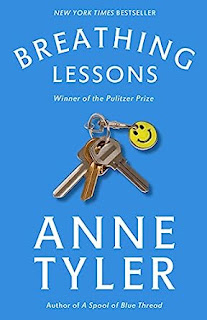
Anne Tyler, Breathing Lessons, 1988

Image
Unfolding over the course of a single emotionally fraught day, this stunning novel encompasses a lifetime of dreams, regrets and reckonings—and is often regarded as Tyler 's seminal work. Maggie and Ira Moran are on a road trip from Baltimore, Maryland to Deer Lick, Pennsylvania to attend the funeral of a friend. Along the way, they reflect on the state of their marriage, its trials and its triumphs—through their quarrels, their routines, and their ability to tolerate each other’s faults with patience and affection. Where Maggie is quirky, lovable and mischievous, Ira is practical, methodical and mired in reason. What begins as a day trip becomes a revelatory and unexpected journey, as Ira and Maggie rediscover the strength of their bond and the joy of having somebody with whom to share the ride, bumps and all. [ Source ] Breathing Lessons

Calvin Trillin, Enough's Enough, and Other Rules of Life, 1990

Image
A collection of pieces by the acclaimed columnist provides insight on numerous aspects of daily life, from car alarms to presidential popularity. [ Source ] Calvin Trillin Enough's Enough, and Other Rules of Life  

Natasha Trethewey, Domestic Work: Poems, 2000

Image
Mississippi native Natasha Trethewey , author of " Bellocq's Ophelia " and " Domestic Work ," has been awarded the Grolier Poetry Prize and a Pushcart Prize. Her work was also included in "The Best American Poetry 2000." Trethewey now lives in Decatur, Georgia, and is Assistant Professor of Creative Writing at Emory University. In this widely celebrated debut collection of poems, Natasha Trethewey draws moving domestic portraits of families, past and present, caught in the act of earning a living and managing their households. Small moments taken from a labor-filled day--and rendered here in graceful and readable verse--reveal the equally hard emotional work of memory and forgetting, the extraordinary difficulty of trying to live with or without someone. [ Source ]  

Paul Theroux, The Mosquito Coast, 1981

Image
The paranoid and brilliant inventor Allie Fox uproots his family from their New England farm to live in the Honduran jungle, determined to build a civilization better than the one they've left. An individualist, Allie sees modern America as wasteful, immoral, and messy. Fleeing from materialism and conformity, he hopes to rediscover a purer life. Told by fourteen-year-old Charlie Fox, who observes his father with a mixture of love, astonishment, and ultimately horror, The Mosquito Coast is a twisted Swiss Family Robinson or an ironic take on Robinson Crusoe. For as Allie becomes ever more lost to reality, this utopian experiment takes a dark turn as his obsessions lead the family toward unimaginable danger. [ Source ] Paul Theroux  

Art Spiegelman, In the Shadow of No Towers, 2004

Image
In the Shadow of No Towers is a masterful and moving account of the events and aftermath of that tragic day. Spiegelman and his family bore witness to the attacks in their lower Manhattan neighborhood: his teenage daughter had started school directly below the towers days earlier, and they had lived in the area for years. But the horrors they survived that morning were only the beginning for Spiegelman, as his anguish was quickly displaced by fury at the U.S. government, which shamelessly co-opted the events for its own preconceived agenda. He responded in the way he knows best. In an oversized, two-page-spread format that echoes the scale of the earliest newspaper comics (which Spiegelman says brought him solace after the attacks), he relates his experience of the national tragedy in drawings and text that convey—with his singular artistry and his characteristic provocation, outrage, and wit—the unfathomable enormity of the event itself, the obvious and insidious effects it had on h...

Elizabeth Snyder, Stories, 1980

Image
An award-winning Southern writer includes thirty-three short stories spanning four decades of her life, portraying her homeland, Mississippi, and other places she has come to love. [ Source ] Elizabeth Spencer Stories  

Gary Snyder, Myths and Texts, 1960

Image
  The three sequences in the book―"Logging," "Hunting," "Burning"―show the remarkable cohesiveness in Snyder 's writings over the years, for we find the poet absorbed, then as now, with Buddhist and Amerindian lore and other interconnections East and West, but above all with the premedical devotion to the land and work. [ Source ] Myths & Texts

Jane Smiley, A Thousand Acres, 1991

Image
When the youngest daughter objects, she is cut out of his will. This sets off a chain of events that brings dark truths to light and explodes long-suppressed emotions. Ambitiously conceived and stunningly written, A Thousand Acres reveals the beautiful yet treacherous topography of humanity. “A family portrait that is also a near-epic investigation into the broad landscape, the thousand dark acres of the human heart.... The book has all the stark brutality of a Shakespearean tragedy.” — The Washington Post Book World [ Source ] Jane Smiley